Wednesday, September 24, 2014

The Classical Influence, part 2

In the previous post I mentioned the use of ancient, classical motifs as decoration in the designs of Robert and James Adam and the guides of Hepplewhite and Sheraton, contrasting this with early 19th century attempts to emulate the designs of ancient furniture. In this post I will show some examples of this use of “classical motifs” in furniture and decorative arts.

One obvious use of classical motifs is the column. Chippendale's Director includes renderings of the classical orders and some of his designs incorporate them, e.g. chimney pieces and clock cases. American Chippendale furniture of the 18th century also utilized the classical orders, especially in case pieces such as secretaries and highboys.

A widely adopted use of the classical column was for candlesticks. Pictured below is a pair of Old Sheffield Plate candlesticks in the form of Doric columns from around 1770. (They are marked with “pseudo hallmarks” which were banned in 1773.)
Old Sheffield Plate candlesticks in the form of Doric columns, English c. 1770.
The vase or urn shape was an especially popular classical motif and was widely used in both furniture and other decorative arts. Pictured below is a Hepplewhite chair which uses the vase or urn shape in the general design of its “shield back” as well as incorporating it into the carving within the shield. Hepplewhite style mirrors are another example.
Hepplewhite side chair, mahogany, English, late 18th or early 19th century. One of a set of six.

Hepplewhite style mirror, 20th century.
This shape was especially popular in the design of neoclassical style silver of the late 18th century. Illustrated below are several examples of various table items in this shape as well as a sugar basket or cream pail decorated with a medallion of a classical figure.
Old Sheffield Plate soup tureen, English c. 1780.

Old Sheffield Plate hot water or tea urn, English c. 1780. Old Sheffield Plate hot water jug, English c. 1780. Jugs or ewers of this type were also used for serving claret.

Old Sheffield Plate sugar basket or cream pail, English c. 1780. The body is formed of four pieces joined together.

R.J.Fendorf
Antiques 
in the Georgian Village
1714 West 45th Street
Kansas City, MO 64111
913.302.3206
jfendorf@yahoo.com

Monday, September 1, 2014

The Classical Influence

Throughout the 18th century, the architecture and art of ancient Greece and Rome were the predominant influence on architecture and design in Great Britain and North America. This classical or “antique” taste is readily seen in the design of buildings and the decoration of rooms, especially in the work of the Adam brothers.

The dining room of Landsdowne House, London, designed by Robert Adam, as installed in the Metropolitan Museum of Art.
While ancient, classical motifs were widely used as decoration in the designs of Robert and James Adam and the guides of Hepplewhite and Sheraton, there were limited attempts to utilize or emulate the actual forms of ancient furniture.
Ancient Greek vase painting showing  a woman playing a lyre seated on a klismos.

Ancient Greek stele depicting a woman seated on a klismos.
This did not really occur until the early 19th century in Britain with the designs of Thomas Hope, who set out to reproduce ancient Greek forms, particularly chairs, and the work of such firms as Gillows of Lancaster.
Chair designs by Thomas Hope.
English mahogany chair (one of a pair) of the Regency/George IV period with low curving crest rail and reeded legs.
Side view showing the “klismos” shape.
In the young United States, this influence was especially strong in classical furniture of major metropolitan areas such as New York and Philadelphia and the painted furniture of Baltimore.
New York classical chair, mahogany, c.1820

Side view showing the continuous line from the top of the stiles to the bottom of the front legs.
Baltimore painted chair, c.1820, decorated with classical motifs in gilt. The overall shape is closer to that of the English chair than the New York example.

R.J.Fendorf
Antiques 
in the Georgian Village
1714 West 45th Street
Kansas City, MO 64111
913.302.3206
jfendorf@yahoo.com

Thursday, August 14, 2014

Classically British ...

I'm not sure what “style” to call a room such as this: classically modern, traditional with a twist, eclectic? I'd probably settle on “classically British.”
Design by Erik Karlsen (London) via Decor & Design Review http://decordesignreview.tumblr.com/
However one describes it, it's a great looking space, containing a variety of pieces mixed in age and style, from a pair of Chippendale side chairs on either side of a contemporary plate glass desk to a Hepplewhite side chair in the right foreground to a Regency or Empire looking bench in left foreground, all against a neutral background. To my eye, what unifies the room and makes it work is the consistent high quality and scale of the pieces. It certainly shows that “brown” furniture has a place in successful contemporary design.
A Centennial Chippendale style mahogany side chair, based on New York designs, American c. 1890

Antique chairs are a great and economical way both to furnish a room and start building a collection. High quality individual chairs are available for a few hundred dollars and pairs of chairs for not much more than that.

One of a pair of Philadelphia Chippendale pierced slat mahogany side chairs, American c. 1780

Prices are better (for the buyer) now than they have been in a long, long time so the opportunity is ripe to acquire quality pieces.

Pictured are a few pieces currently available from my inventory and other dealers on the street have comparable pieces.


A Centennial Chippendale Gothic style mahogany side chair, based on Philadelphia designs, American c. 1900


One of a pair of George IV mahogany drawing room chairs, English c. 1825


R.J.Fendorf
Antiques 
in the Georgian Village
1714 West 45th Street
Kansas City, MO 64111
913.302.3206
jfendorf@yahoo.com 

Tuesday, May 6, 2014

Why I'm not a decorator...

I would never have thought of using these sconces

in a bathroom until I saw this
from The Foo Dog Ate My Homework.  I guess I was on the right track with the Chippendale mirror.

R.J.Fendorf
Antiques 
in the Georgian Village
1714 West 45th Street
Kansas City, MO 64111
913.302.3206
jfendorf@yahoo.com


Thursday, April 17, 2014

Four chairs from two centuries and two continents


In this post and several to follow, I am going to examine and compare four different chairs, two from North America and two from Europe, one from the last quarter of the 18th century and three from the first quarter of the 19th century.
Philadelphia Chippendale Chair c. 1780
The first chair, actually one of a pair, is a Philadelphia Chippendale chair from about 1780, or perhaps a little earlier. The design is a very well documented Philadelphia style and is variously described as “ladder-back” (Fine Points of Furniture, Early American by Albert Sack, 1950 ed., p.48), “slat or splat back” (American Furniture, The Federal Period by Charles F. Montgomery, plate 83), and sometimes “ribbon back.” The chair has three serpentine curved, pierced slats or splats, rounded shoulders and a serpentine curved, pierced crest rail. The legs are square/straight with a beaded edge. The seat front is straight with a beaded edge. The chair is constructed of mahogany with pine secondary woods. The chair (and its mate as well) has the original pine slip-seat frame chisel-marked “I”. (The other chair is marked “III” and the slip-seat “II” so they were part of a larger set and at least two slip-seats were switched.)
Philadelphia Chippendale chair, side view
 Albert Sack rates such a chair as “best” on his “good, better, best” scale with this commentary:
Chippendale mahogany ladder-back side chair, Philadelphia, circa 1750-1780. A typical example of a fine Philadelphia chair. Dozens of similar sets of this pattern were made in and around Philadelphia. The rounded contours where the back posts meet the crest and the typical serpentine crest with its molded edge vary but little in the many examples in existence. The chief differences occur in the seat fronts, which are sometimes straight and sometimes serpentine – also in the legs which are either molded or have a beaded edge.


The earlier examples tend to have a straight seat front and straight or square legs with beaded edges, the later serpentine seat fronts with tapered, molded legs.

Straight or square leg with beaded edge
The chair listed by Montgomery is described as “with round shoulders” and has the following commentary:
William Macpherson Hornor, Jr., states that Thomas Tufft made a set of twelve of this kind for Deborah Norris Logan of Stenton in 1783 and that six others were fashioned by Jacob Wayne for Captain Thomas Mason in 1790. An example of each set is illustrated in The Blue Book of Philadelphia Furniture, Plates 289 and 101, respectively. Both chairs are virtually identical to the one shown here. All three have stretchers, molded tapered legs, slip seats, and serpentine front rails. Two other chairs in the Winterthur collection, almost identical to this pair except for having straight seat fronts, have the side rails tenoned through the back legs in the normal manner of Philadelphia chairmaking. These are not tenoned through the rear legs. 

Round shoulder and pierced, serpentine crest rail
 Montgomery also illustrates an armchair of similar design and Sack four New England Chairs with similar pierced horizontal slats but with “ears” rather than round shoulders. The chair (pair) discussed here does not have the side rails tenoned through the back legs but, as noted above and in other Winterthur examples, while this technique was common in Philadelphia chairmaking it was not universal.
Pine slip-seat frame with chisel mark "I"
 A pair of chairs believed to be part of the Logan family chairs were recently purchased by Stenton (a house museum) for the hammer price of $18,000.  You can also visit the website of James Wm. Lowry to see a similar chair of slightly later date with straight but molded legs.

R.J.Fendorf
Antiques 
in the Georgian Village
1714 West 45th Street
Kansas City, MO 64111
913.302.3206
jfendorf@yahoo.com

Saturday, February 8, 2014

For all your Valentine's Day needs ...

and desires


 All available at Joseph's.

Joseph's
Joseph Candioto, owner
1714 W. 45th Street (in The Georgian Village)
Kansas City, MO 64111
Thurs.   10:30 - 3:30
Fri.        10:30 - 4:00
Sat.       10:30 - 4:00
816-756-5553
josephcandioto@aol.com

Friday, December 6, 2013

We're in the holiday mood

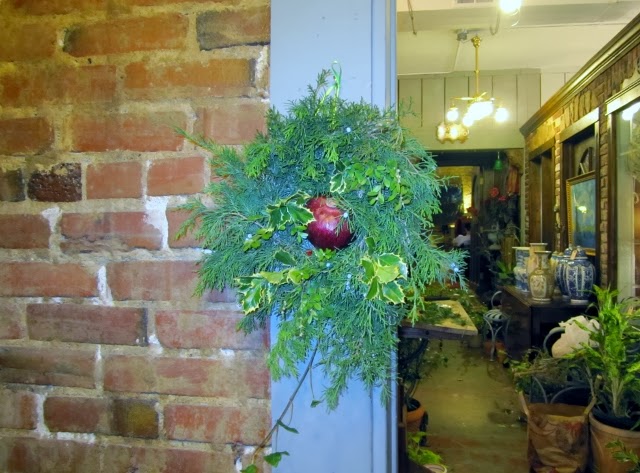
and we have handmade, all natural holiday wreaths available.


Prices range from $25 to $75.  Drop by the Georgian Village and take a look!

The Georgian Village
1714 W. 45th St.
Kansas City, MO 64111